Breakout vs Arkanoid: What Is Actually Different?

People use Breakout and Arkanoid as if they were two names for the same thing. They are not. Both give you a paddle, a ball and bricks, and from there they diverge enough that a player who is excellent at one can be distinctly average at the other.
The difference is not cosmetic and it is not about graphics. Arkanoid changed what the player is asked to decide. This article sets out exactly what changed, what each style rewards, and which one you should play depending on what you want out of a session.
The one-line answer
Breakout is a pure execution test. Arkanoid is an execution test plus a resource-management game.
In a Breakout-style game, every point of failure traces back to one thing: did you put the paddle in the right place, at the right angle, in time? In an Arkanoid-style game, you can execute perfectly and still lose because you caught a capsule you should have dodged, or spent three seconds chasing one you did not need.
What Arkanoid added in 1986
Falling capsules
Arkanoid's defining addition. Destroying certain bricks releases a capsule that drifts downwards; catching it with your paddle applies an effect. The original set included paddle expansion, a laser that let you shoot bricks directly, a catch effect that stuck the ball to the paddle, a slow-ball effect, a three-way ball split, a level-skip warp and an extra life.
Critically, catching a capsule requires being in a specific place at a specific time - which is often not where the ball needs you to be. That tension is the mechanic's whole point.
Brick durability
Breakout's bricks all die in one hit. Arkanoid introduced silver bricks needing multiple hits (scaling with the level) and gold bricks that cannot be destroyed at all. Indestructible bricks are a level-design tool rather than an obstacle: they let the designer shape rebound paths permanently.
Designed layouts
Breakout is a uniform rectangle of bricks. Arkanoid's stages are drawn - patterns, shapes, deliberate gaps and channels. This changes the geometry of the game: a uniform wall produces predictable rebounds, while an irregular layout produces angles you have to read on the fly.
A boss fight
The final stage puts a moving target on screen that fights back. It gives the game an ending rather than a score, which matters more than it sounds - a game with an ending creates a different kind of session.
How the two styles feel to play
| Breakout style | Arkanoid style | |
|---|---|---|
| Primary skill | Angle control and positioning | Angle control plus decision-making under pressure |
| Failure cause | You missed the ball | You were out of position, often for a good reason |
| Pace | Steady, accelerating | Spiky - calm, then chaotic after a multi-ball |
| Screen reading | One ball to track | Ball(s), capsules and brick states at once |
| Level design role | Minor - the wall is a wall | Major - layouts are puzzles |
| Best for | Players who want a clean skill ceiling | Players who want variety and momentum swings |
Neither is harder in the abstract. A stripped-back Breakout with an accelerating ball is punishing in a way no capsule can rescue you from; an Arkanoid-style game with harmful capsules can punish greed in a way a pure game never does.
Try the difference rather than reading about it
This site has both branches built on the same engine, which makes the comparison unusually clean - the collision code, paddle physics and rebound maths are identical, so any difference you feel is a design difference rather than an implementation one.
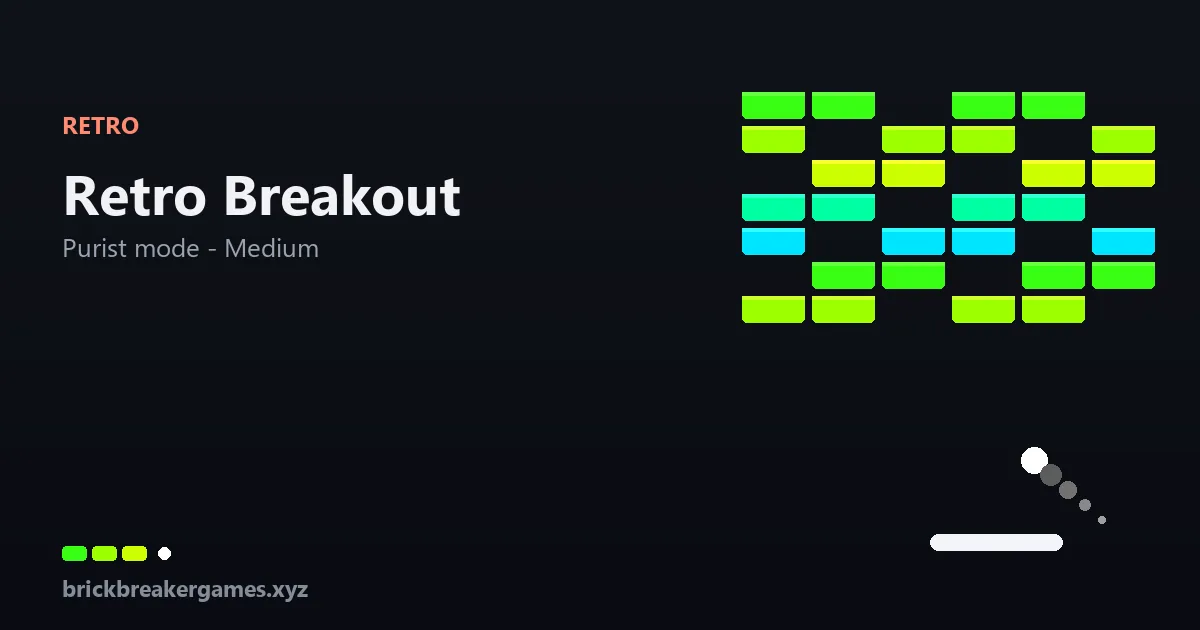
- Retro Breakout is the Breakout branch: single-hit bricks, no capsules at all, and a ball that accelerates on every paddle return.
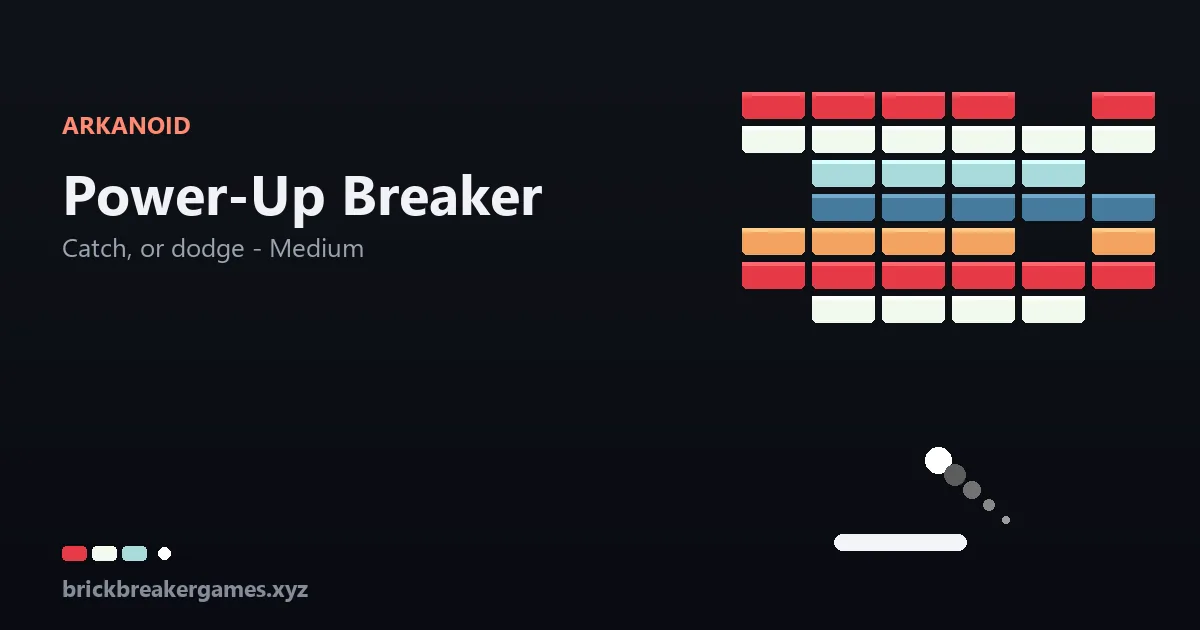
- Power-Up Breaker is the Arkanoid branch taken to its logical end: ten capsule types including two that actively harm you.
Play one level of each back to back. The thing most people notice first is that their eyes move differently - Breakout keeps your gaze on the ball, Arkanoid keeps pulling it away.
How each style handles its endgame
A difference nobody mentions and everybody feels: the two styles behave completely differently once the wall is mostly gone.
In a Breakout-style game, the endgame is the hardest part by design. Fewer bricks means longer travel, longer travel means more paddle returns, and in a game with acceleration each of those returns makes the ball faster. So the last five bricks are chased with a ball moving at close to its maximum speed, with nothing available to help you. Players who lose runs in Breakout-style games overwhelmingly lose them in the final 20 percent of a level.
In an Arkanoid-style game, the endgame is often the easiest part. By the time the wall is thin you have usually accumulated a wider paddle, or a multi-ball is still in play, or you are holding a capsule effect that makes the clean-up trivial. The difficulty sits in the middle of the level instead, when capsules are falling thickest and there is most to track.
This has a direct practical consequence for how you should pace yourself.
- In a Breakout-style game, take your risks early. The opening of a level is the only time the ball is slow enough to chase awkward bricks safely. Build the channel while it is cheap.
- In an Arkanoid-style game, survive the middle. Play conservatively when the screen is busiest, decline capsules that pull you out of position, and expect the clean-up to be comfortable.
Players who carry the wrong instinct across get it backwards in both directions: cautious in a slow opening where caution costs nothing, and greedy in a fast endgame where greed costs everything.
Which skills transfer and which do not
Transfers completely: paddle contact-point control, interception positioning, reading rebound angles off walls and bricks, tunnelling above the wall.
Transfers partly: pace management. Breakout players learn to handle acceleration; Arkanoid players learn to handle sudden multi-ball chaos. Both are composure skills but they feel different.
Does not transfer: capsule triage. Deciding in half a second whether a falling capsule is worth leaving your position for is a skill that simply does not exist in a pure Breakout game, and it is the most common reason strong Breakout players underperform when they move across. There is more on this in power-ups explained.
A checklist for classifying any brick breaker
You can place almost any brick breaker on the spectrum in about thirty seconds. Play one level and answer six questions.
- Does anything fall from destroyed bricks? If no, it is Breakout-side. If yes, it is Arkanoid-side. This single question settles most cases.
- Do all bricks die in one hit? Uniform durability points to Breakout; counters and indestructible blocks point to Arkanoid.
- Is the wall a rectangle or a shape? A uniform grid is Breakout-side. A drawn layout with deliberate gaps is Arkanoid-side.
- Does the ball accelerate on its own? Escalating speed is a Breakout inheritance. Arkanoid-descended games more often control pace through capsules.
- Is there an ending? A boss or a final stage is an Arkanoid trait. A score that simply keeps climbing is a Breakout trait.
- Can you lose by catching something? Harmful capsules exist only on the Arkanoid side, and they are the clearest sign the designer wants you making decisions rather than just executing.
Most modern games answer a mix, which is fine - the point of the checklist is not to produce a label but to tell you what the game will ask of you before you have invested an hour in it.
Four things people get wrong about the comparison
"Arkanoid is just Breakout with power-ups." The capsules are the visible change; the durability tiers and designed layouts matter at least as much. Indestructible gold bricks alone transform level design, because they let a designer fix part of the playfield geometry permanently.
"Breakout-style games are easier." Usually the opposite. Without capsules there is no recovery mechanic, so a run that starts badly continues badly. Add an acceleration rule and the end of every level is the hardest part.
"Power-ups make a game more casual." They make it more forgiving in some moments and less forgiving in others. A capsule you chase across the screen is a deliberate risk the designer put in your path, and harmful capsules punish greed in a way a pure skill game never does.
"The skills are the same." Angle control and positioning transfer completely. Capsule triage - deciding in half a second whether a falling item is worth leaving position for - does not exist on the Breakout side at all, which is why strong Breakout players often underperform when they first move across.
Naming, clones and what the terms mean today
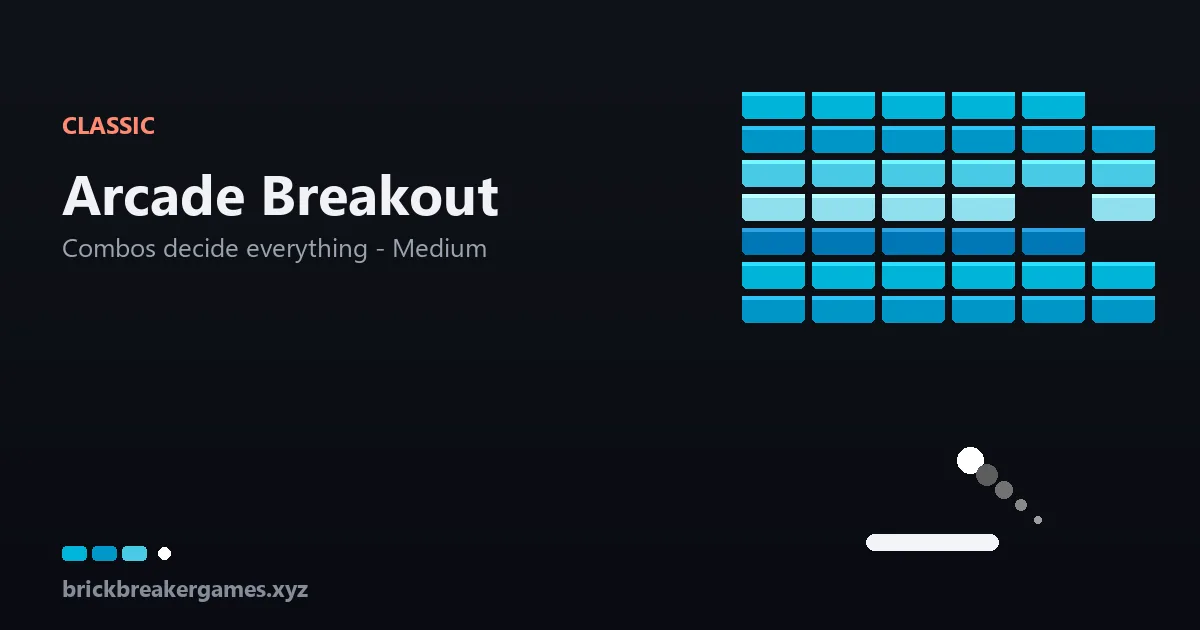
In modern usage, 'Breakout clone' usually signals a minimal game, and 'Arkanoid-style' signals capsules and designed stages. Neither term is precise, and plenty of games mix the two - our Arcade Breakout, for example, is visually a Breakout descendant but uses a combo multiplier that changes the strategy completely.
One point worth stating plainly: Breakout and Arkanoid are trademarks belonging to their respective rights holders. Discussing them editorially is normal and legitimate. Using the names to describe your own game is not, and none of the games on this site does so - they are original implementations inspired by the genre, which is why they have their own names.
Editor’s note
If you want to test which style suits you, count your deaths. In a Breakout-style game, note whether you lost the ball because you were late or because you chose a bad angle. In an Arkanoid-style game, note how many of your losses happened within two seconds of catching or chasing a capsule. Most players find one of those two numbers is dramatically larger, and that tells you which branch of the genre you are naturally suited to.
— Daniel Carter, Arcade Gaming Editor & Browser Game Researcher
Frequently asked questions
Is Arkanoid a Breakout clone?
Arkanoid is a descendant rather than a clone. It uses the same paddle-and-ball core but adds capsules, brick durability tiers, designed level layouts and a boss fight, which changes what the player is deciding moment to moment.
Which is harder, Breakout or Arkanoid?
They are hard in different ways. Breakout-style games punish imprecision, because there is nothing to rescue a bad rally. Arkanoid-style games punish poor judgement, because chasing the wrong capsule loses position.
What power-ups did the original Arkanoid have?
The capsule set included paddle expansion, a laser, a catch effect, a slow-ball effect, a three-ball split, a level warp and an extra life.
Are gold bricks in Arkanoid destructible?
No. Gold bricks cannot be destroyed and stay on screen for the whole stage, which makes them a level-design tool for shaping rebound paths rather than an obstacle to remove.
Can I play both styles on this site?
Yes. Retro Breakout is the stripped-back branch and Power-Up Breaker is the capsule-heavy branch. Both run on the same engine, so the comparison is a fair one.
Key takeaways
- Breakout tests execution; Arkanoid tests execution plus decision-making.
- Arkanoid's four additions - capsules, durability tiers, designed layouts, a boss - became the genre template.
- Indestructible bricks are a design tool for shaping rebounds, not just an obstacle.
- Angle control transfers between both styles; capsule triage does not.
- Breakout and Arkanoid are trademarks. Games inspired by them should carry their own names, as ours do.
Conclusion
The two names describe two genuinely different games that happen to share a control scheme. If you want a clean, escalating test of precision, the Breakout branch is the one to play. If you want swings of momentum and decisions with consequences, the Arkanoid branch will hold your attention longer.
Most players end up preferring one strongly. The quickest way to find out which is to play a level of each and notice where your eyes go.
Try it yourself
Reading about paddle angles only goes so far. Play Power-Up Breaker and put it into practice.
References and further reading
Also covers: difference between breakout and arkanoid, arkanoid style games, breakout style games, arkanoid power ups